Exciting Developments in Packaging & Systems Integration for Quantum Technologies at UCC’s Tyndall National Institute
IrelandQCI, the ‘Building a National Quantum Communication Infrastructure for Ireland’ project incorporates integrating innovative and secure quantum devices and systems into conventional communication infrastructures. Technology specialists in six universities are pooling their expertise and resources to add an extra security layer to Ireland’s communication infrastructure and the data it transmits.
UCC’s Tyndall National Institute plays a vital role in the consortium of IrelandQCI partners. Tyndall is a leading European research centre in integrated ICT materials, devices and systems. It is one of Ireland’s five National Labs, specialising in both electronics and photonics. The Photonics Packaging and Systems Integration Group at Tyndall addresses challenges in photonic and microelectronic technologies, from fundamental research to the transition to pilot-scale manufacturing with its unique technical expertise across a wide range of advanced photonic and microelectronic packaging and integration technologies.
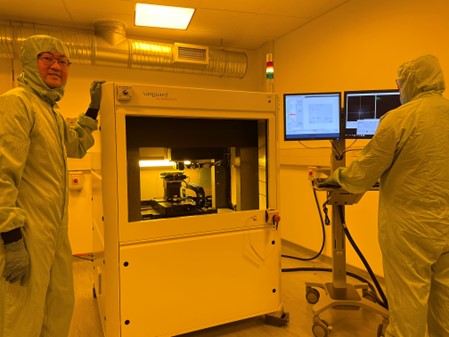
Recently, the Group at Tyndall, led by Professor Peter O’Brien, purchased a micro-optics 3D printer with submicron resolution from Vanguard Automation, in Germany. Professor O’Brien explains the significance of this equipment now being in operation at Tyndall, and the opportunities this provides through the IrelandQCI project, ‘In the IrelandQCI project, we plan to develop more robust packaging solutions for cryogenic environments, which are essential for many low-noise quantum applications. Based on our prior expertise, we will also prepare training courses on photonic packaging, specifically for users of quantum technologies. Ultimately, we would like to combine these new courses with our well-established PhotonHub syllabus. To help us achieve these ambitious objectives, we are purchasing new packaging equipment. Figure 1 shows a recently purchased micro-optics 3D printer with submicron resolution from Vanguard Automation in Germany. The equipment will be used to develop novel low-loss optical interconnect solutions for quantum applications, which is a core technical focus in the project. Through IrelandQCI project, we are confident we can ensure Ireland plays a leading role in Europe to develop and exploit novel and exciting quantum engineering technologies.’
Figure: State-of-the-art micro-optics 3D printer with submicron resolution from Vanguard Automation has been installed and is now operational at the Tyndall Institute. The equipment has been funded under the IrelandQCI project. The photo shows Dr How Yuan Huang and Dr. Kamil Gradkowski, who are members of Tyndall’s Photonic Packaging & Systems Integration Group, which is led by Prof. Peter O’Brien.
The Photonics Packaging and Systems Integration Group
Photonics Packaging and Systems Integration Group develops advanced technologies to enable photonic and electronic chips to operate and communicate with their external environment. The process of packaging semiconductor chips typically costs significantly more than the cost of the chips themselves. Therefore, there are significant technical and engineering challenges to overcome in developing new materials, faster and more efficient assembly processes, precise automated equipment and standardised process design flows. However, our group not only develops the core technologies but we are also recognised as a leader in developing the ecosystem, ensuring synergy between chip designers, foundries, packaging providers and end-users.
The Group has a strong presence at international conferences and workshops, leading technology roadmaps and providing training courses for new researchers and companies entering the world of photonics and electronics. Regarding the core technologies, they develop solutions to assemble fibre optics and micro-optics with nanometre-scale precision aligned to the photonic chips. They also develop electrical solutions to enable photonic and electronic chips to communicate at extremely high speeds. This requires a large team of highly experienced researchers and advanced equipment in state-of-the-art cleanrooms. The Group’s unique expertise has resulted in leading equipment companies locating in the Tyndall labs, where they collaborate to optimise their machines based on Tyndall’s advanced packaging and integration processes. This includes placing experienced company engineers in the labs for the long term. It’s a mutually beneficial relationship. This collaborative approach is an example to other leading researchers worldwide, showing how they can maximise their research impacts through close collaboration.
Professor O’Brien elaborates further on the importance of close collaboration, ‘The Photonics Packaging and Systems Integration Group is recognised as a world leader in developing novel photonic and electronic integration technologies. Much of this is achieved through close collaboration with other leading researchers worldwide. For example, we lead Europe’s Photonics Packaging Pilot Line (www.pixapp.eu) and the European Photonics Academy at PhotonHub Europe (www.photonhub.eu). In the Academy, we manage training and education activities for 50 of Europe’s leading research institutes and universities. We have also extended our research activities into the US, collaborating with leading universities including MIT, Columbia, Berkeley, Harvard and University of Arizona. We also collaborate with companies including Intel, Samsung, Boeing, Microsoft, Meta, Medtronic, Zeiss, and many SMEs. More recently, our unique expertise in advanced photonic and electronic packaging and integration technologies has enabled us to begin addressing unique challenges in building quantum systems. This has opened the door to many collaboration opportunities in Europe and the US. For example, we recently joined as a partner in the European Quantum Flagship project (www.qt.eu). Our unique approach is to develop standardised or baseline photonic and electronic assembly processes, which provides researchers with an easier path to develop their quantum applications. This unique approach bridges-the-gap between research and commercialisation, which is a key focus of our group.’
UCC’s Tyndall National Institute is a consortium partner of IrelandQCI. Read more about the members of the consortium here: https://irelandqci.ie/the-consortium/
This mode enables people with epilepsy to use the website safely by eliminating the risk of seizures that result from flashing or blinking animations and risky color combinations.
Visually Impaired Mode
Improves website's visuals
This mode adjusts the website for the convenience of users with visual impairments such as Degrading Eyesight, Tunnel Vision, Cataract, Glaucoma, and others.
Cognitive Disability Mode
Helps to focus on specific content
This mode provides different assistive options to help users with cognitive impairments such as Dyslexia, Autism, CVA, and others, to focus on the essential elements of the website more easily.
ADHD Friendly Mode
Reduces distractions and improve focus
This mode helps users with ADHD and Neurodevelopmental disorders to read, browse, and focus on the main website elements more easily while significantly reducing distractions.
Blindness Mode
Allows using the site with your screen-reader
This mode configures the website to be compatible with screen-readers such as JAWS, NVDA, VoiceOver, and TalkBack. A screen-reader is software for blind users that is installed on a computer and smartphone, and websites must be compatible with it.
Online Dictionary
Readable Experience
Content Scaling
Default
Text Magnifier
Readable Font
Dyslexia Friendly
Highlight Titles
Highlight Links
Font Sizing
Default
Line Height
Default
Letter Spacing
Default
Left Aligned
Center Aligned
Right Aligned
Visually Pleasing Experience
Dark Contrast
Light Contrast
Monochrome
High Contrast
High Saturation
Low Saturation
Adjust Text Colors
Adjust Title Colors
Adjust Background Colors
Easy Orientation
Mute Sounds
Hide Images
Hide Emoji
Reading Guide
Stop Animations
Reading Mask
Highlight Hover
Highlight Focus
Big Dark Cursor
Big Light Cursor
Cognitive Reading
Virtual Keyboard
Navigation Keys
Voice Navigation
Accessibility Statement
irelandqci.ie
October 23, 2026
Compliance status
We firmly believe that the internet should be available and accessible to anyone, and are committed to providing a website that is accessible to the widest possible audience,
regardless of circumstance and ability.
To fulfill this, we aim to adhere as strictly as possible to the World Wide Web Consortium’s (W3C) Web Content Accessibility Guidelines 2.1 (WCAG 2.1) at the AA level.
These guidelines explain how to make web content accessible to people with a wide array of disabilities. Complying with those guidelines helps us ensure that the website is accessible
to all people: blind people, people with motor impairments, visual impairment, cognitive disabilities, and more.
This website utilizes various technologies that are meant to make it as accessible as possible at all times. We utilize an accessibility interface that allows persons with specific
disabilities to adjust the website’s UI (user interface) and design it to their personal needs.
Additionally, the website utilizes an AI-based application that runs in the background and optimizes its accessibility level constantly. This application remediates the website’s HTML,
adapts Its functionality and behavior for screen-readers used by the blind users, and for keyboard functions used by individuals with motor impairments.
If you’ve found a malfunction or have ideas for improvement, we’ll be happy to hear from you. You can reach out to the website’s operators by using the following email
Screen-reader and keyboard navigation
Our website implements the ARIA attributes (Accessible Rich Internet Applications) technique, alongside various different behavioral changes, to ensure blind users visiting with
screen-readers are able to read, comprehend, and enjoy the website’s functions. As soon as a user with a screen-reader enters your site, they immediately receive
a prompt to enter the Screen-Reader Profile so they can browse and operate your site effectively. Here’s how our website covers some of the most important screen-reader requirements,
alongside console screenshots of code examples:
Screen-reader optimization: we run a background process that learns the website’s components from top to bottom, to ensure ongoing compliance even when updating the website.
In this process, we provide screen-readers with meaningful data using the ARIA set of attributes. For example, we provide accurate form labels;
descriptions for actionable icons (social media icons, search icons, cart icons, etc.); validation guidance for form inputs; element roles such as buttons, menus, modal dialogues (popups),
and others. Additionally, the background process scans all the website’s images and provides an accurate and meaningful image-object-recognition-based description as an ALT (alternate text) tag
for images that are not described. It will also extract texts that are embedded within the image, using an OCR (optical character recognition) technology.
To turn on screen-reader adjustments at any time, users need only to press the Alt+1 keyboard combination. Screen-reader users also get automatic announcements to turn the Screen-reader mode on
as soon as they enter the website.
These adjustments are compatible with all popular screen readers, including JAWS and NVDA.
Keyboard navigation optimization: The background process also adjusts the website’s HTML, and adds various behaviors using JavaScript code to make the website operable by the keyboard. This includes the ability to navigate the website using the Tab and Shift+Tab keys, operate dropdowns with the arrow keys, close them with Esc, trigger buttons and links using the Enter key, navigate between radio and checkbox elements using the arrow keys, and fill them in with the Spacebar or Enter key.Additionally, keyboard users will find quick-navigation and content-skip menus, available at any time by clicking Alt+1, or as the first elements of the site while navigating with the keyboard. The background process also handles triggered popups by moving the keyboard focus towards them as soon as they appear, and not allow the focus drift outside it.
Users can also use shortcuts such as “M” (menus), “H” (headings), “F” (forms), “B” (buttons), and “G” (graphics) to jump to specific elements.
Disability profiles supported in our website
Epilepsy Safe Mode: this profile enables people with epilepsy to use the website safely by eliminating the risk of seizures that result from flashing or blinking animations and risky color combinations.
Visually Impaired Mode: this mode adjusts the website for the convenience of users with visual impairments such as Degrading Eyesight, Tunnel Vision, Cataract, Glaucoma, and others.
Cognitive Disability Mode: this mode provides different assistive options to help users with cognitive impairments such as Dyslexia, Autism, CVA, and others, to focus on the essential elements of the website more easily.
ADHD Friendly Mode: this mode helps users with ADHD and Neurodevelopmental disorders to read, browse, and focus on the main website elements more easily while significantly reducing distractions.
Blindness Mode: this mode configures the website to be compatible with screen-readers such as JAWS, NVDA, VoiceOver, and TalkBack. A screen-reader is software for blind users that is installed on a computer and smartphone, and websites must be compatible with it.
Keyboard Navigation Profile (Motor-Impaired): this profile enables motor-impaired persons to operate the website using the keyboard Tab, Shift+Tab, and the Enter keys. Users can also use shortcuts such as “M” (menus), “H” (headings), “F” (forms), “B” (buttons), and “G” (graphics) to jump to specific elements.
Additional UI, design, and readability adjustments
Font adjustments – users, can increase and decrease its size, change its family (type), adjust the spacing, alignment, line height, and more.
Color adjustments – users can select various color contrast profiles such as light, dark, inverted, and monochrome. Additionally, users can swap color schemes of titles, texts, and backgrounds, with over seven different coloring options.
Animations – person with epilepsy can stop all running animations with the click of a button. Animations controlled by the interface include videos, GIFs, and CSS flashing transitions.
Content highlighting – users can choose to emphasize important elements such as links and titles. They can also choose to highlight focused or hovered elements only.
Audio muting – users with hearing devices may experience headaches or other issues due to automatic audio playing. This option lets users mute the entire website instantly.
Cognitive disorders – we utilize a search engine that is linked to Wikipedia and Wiktionary, allowing people with cognitive disorders to decipher meanings of phrases, initials, slang, and others.
Additional functions – we provide users the option to change cursor color and size, use a printing mode, enable a virtual keyboard, and many other functions.
Browser and assistive technology compatibility
We aim to support the widest array of browsers and assistive technologies as possible, so our users can choose the best fitting tools for them, with as few limitations as possible. Therefore, we have worked very hard to be able to support all major systems that comprise over 95% of the user market share including Google Chrome, Mozilla Firefox, Apple Safari, Opera and Microsoft Edge, JAWS and NVDA (screen readers).
Notes, comments, and feedback
Despite our very best efforts to allow anybody to adjust the website to their needs. There may still be pages or sections that are not fully accessible, are in the process of becoming accessible, or are lacking an adequate technological solution to make them accessible. Still, we are continually improving our accessibility, adding, updating and improving its options and features, and developing and adopting new technologies. All this is meant to reach the optimal level of accessibility, following technological advancements. For any assistance, please reach out to